
You want to know your pet's backstory.
Does your pet want to talk about it?
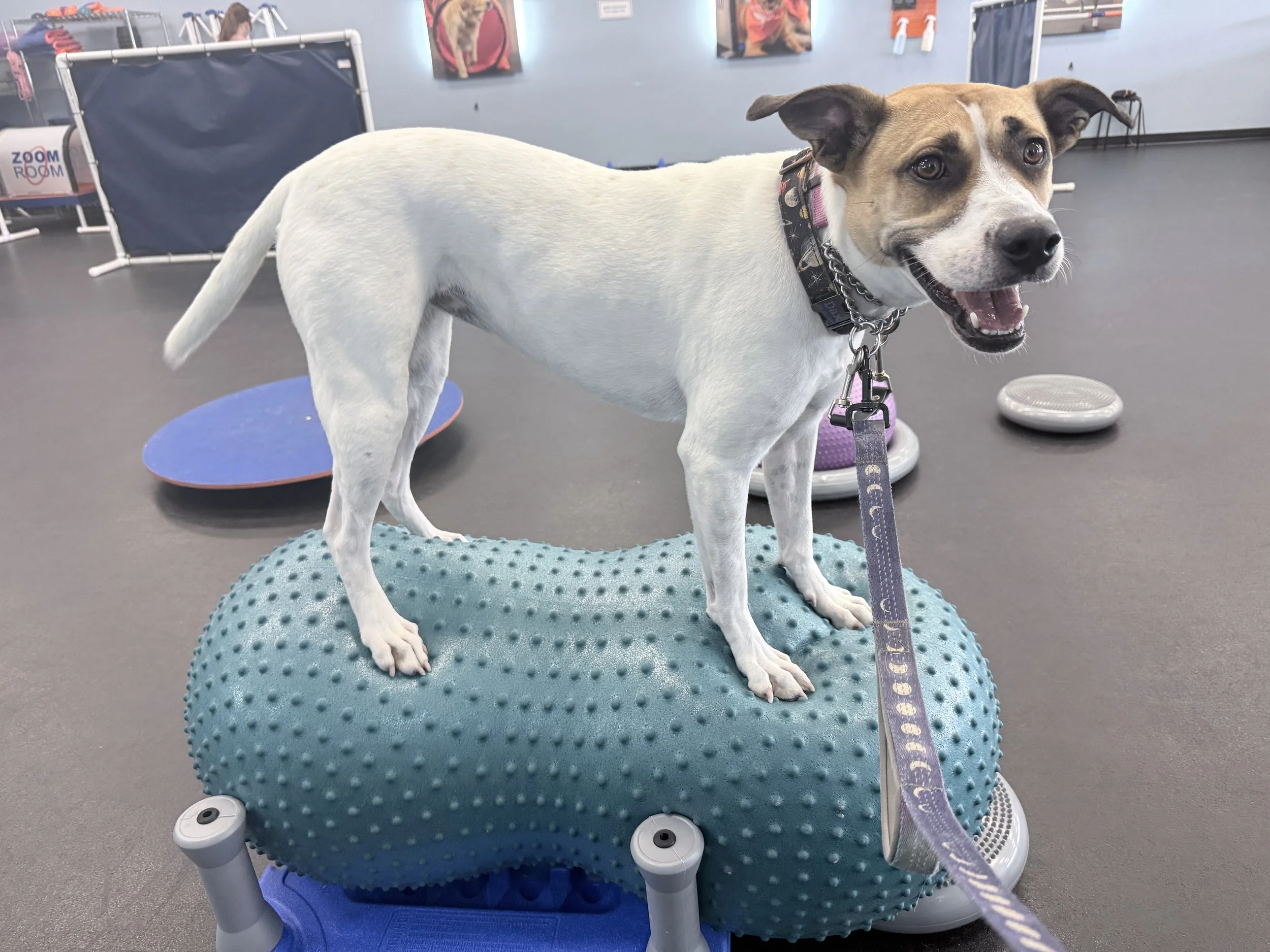
Dax in her happy place at Puplates
When an animal communication reading turns toward an animal's past, I frequently feel it in my body first. A tightness. A pull back, like the animal has stepped half a step behind itself.
A fellow animal communicator friend of mine said something recently that named exactly what I was feeling: animals live in the present moment, and the more we focus on their history, the more it holds them back.
As an animal communicator I see this with clients. People come to me wanting the backstory.
What was their life like before they came to them?
What happened to make them this way?
Why does she do the thing she does?
These are natural questions rooted in curiosity and a yearning for understanding our companion animals. We're storytelling creatures, we want the explanation, the origin, the reason. It feels like understanding, like knowing is a form of love.
But here's what I've noticed, over and over in readings: the animals themselves don't want to go there. When a reading turns toward history, toward digging up what happened, I feel the animal pull back. Sometimes they’ll share glimpses but they don’t like to go deep.
On occasion the client will push. I advocate for the animal and tell them what I’m feeling from the animal and that they don’t want to go there. Animals have boundaries that need to be honored.
Animals show up in a way of being that most of us have lost access to. They don't ruminate on what happened to them. They don't build an identity out of it.
Maybe holding on to the past is about us and not them. It's easier to hold a dog's fear if we have a reason for it. A reason turns something frightening into something explainable, and explainable feels safer than a misunderstood behavior.
For example, my dog Dax spent 6 months in a kill shelter where I know she was treated poorly. The past shaped her, yes. It's in her body, in her startle reflex, in the way she reacts to triggers and stimuli. But it isn't where she's living.
I know Dax's history. I could tell it to you in detail, where she came from, what happened to her before she was mine, the shape of the fear that still shows up in her body sometimes. I've told that story to other people. I've told it to myself, probably more than I've told it to anyone. I think I started treating Dax like the story instead of like the dog in front of me.
That's the part that stopped me. Not that I knew her history, knowing it isn't the problem. The problem was using it as the lens I looked through every single day, instead of a chapter that's already been written. When she gets reactive, I'd think about why. When she hesitated or put her head down, I'd think about what she'd been through. All of it true, none of it useless exactly, but all of it pointed backward, at a version of her that doesn't exist anymore.
What she needs most from me is meeting her now as a smart, funny and confident dog that occasionally reacts from past traumas.
With Dax, I'm trying to unlearn that pattern of bringing up her past in my mind. When she's anxious now, I'm practicing asking a different question.
"What does she need right now?"
Staying with Dax in the present moment is a gift for both of us. We’re learning this lesson together
If you're working with an animal who carries a hard or mysterious history, I'd offer this: you don't have to know the whole story to help. Sometimes not knowing it, or setting it down even when you do, is what lets the animal actually meet you.
They need you to show up for who they are today.
That's the whole practice, really. Not forgetting where they came from. Just refusing to let it be the main place you look.